
The collapse of visual certainty
At first, we thought we would always be able to tell. A strange finger, a distorted eye or a slightly ‘off’ face. For a brief moment, detecting AI images felt like a skill.
That moment is over.
Today, even experts can no longer reliably explain why an image looks real—or not.
And yet, we continue to trust the tools that claim they can.
After building a forensic image analysis system from the ground up, I’ve come to a blunt conclusion: AI image detection, as commonly implemented today, is fundamentally flawed.
This article explains why, and more importantly: what actually works instead.
The Illusion of Detection
Most tools today operate like this. You upload an image to a website (or API), behind which sits a pre trained neural network –a classifier of some sort (e.g. XGBoost)- that returns a probability score, ‘AI-generated: 87%’.
Any image can contain compression artifacts, camera processing artifacts, repeated textures, geometric structures and real-world anomalies. Yet the detector outputs a single probability. That is not analysis, this is compression.
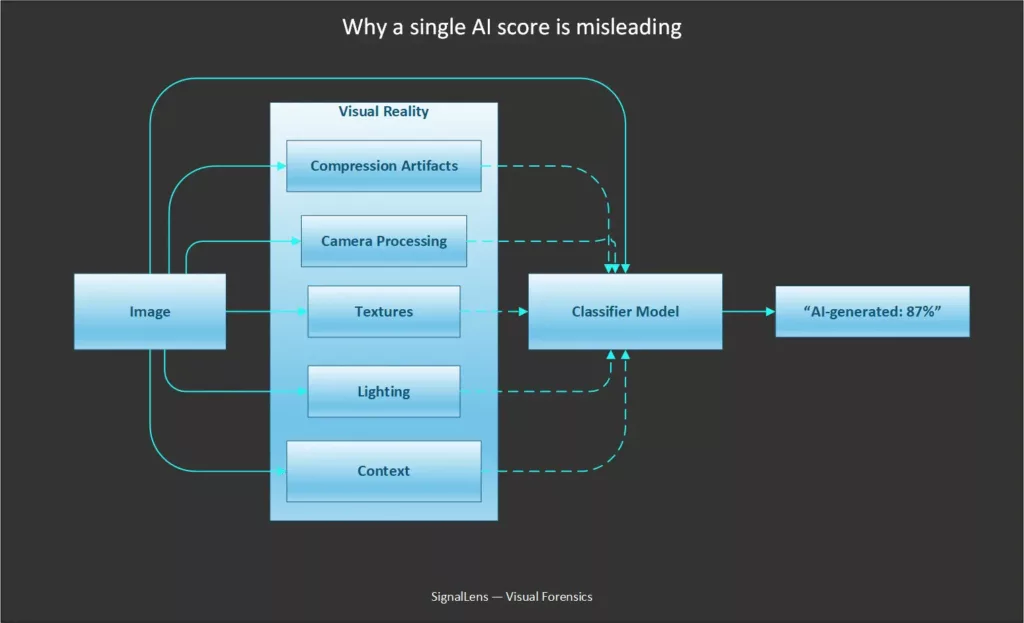
That number looks scientific. It feels authoritative. But it hides a critical truth: the model itself does not understand the image – it recognizes patterns. That distinction matters more than most people realize.
Such a detector cannot know whether an image comes from a smartphone photo processing pipeline. Nor can it determine whether a pattern is intentional architectural repetition, or whether lighting inconsistencies are natural or synthetic.
Yet in the real world these contextual factors often are decisive.
Why Classifiers Fail (systematically)
Let’s break this down.
Classifiers, like all neural networks learn from the past – not the present. AI detectors are trained on datasets of known real and known synthetic images. During training they learn statistical differences between these sets.
However, image generating models now evolve faster than datasets. Today’s generator is not compatible with yesterday’s training data. As a result, when confronted with new material, classifiers produce:
- false negatives (AI images classified as real), and
- false positives (real images flagged as AI).
The New Aesthetic of AI
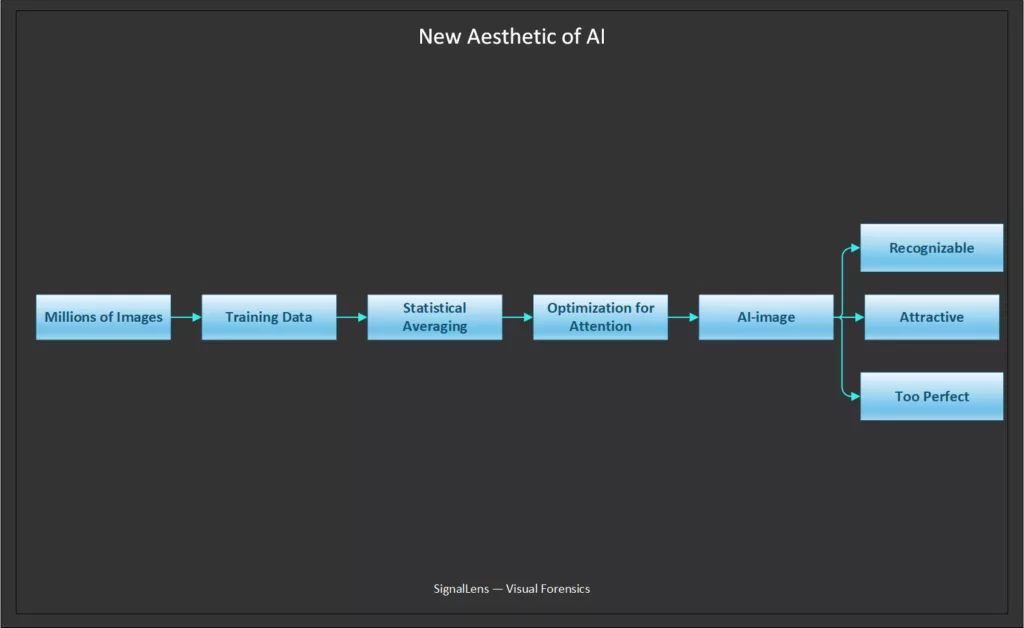
AI images used to look wrong. Now they look…right, even too right! They are well-lit, highly-symmetrical, emotionally legible and optimized for attracting attention.
But this is not really realism. It is optimization. AI does not invent faces; it produces the statistical average of everything we already find appealing.
Research has shown that when multiple faces are averaged together, the result is often perceived as more attractive than any individual face. Experiments in the 1990s demonstrated that perceived attractiveness of averaged human faces increases with the number of individual faces contributing to a morphed composite image.
Modern AI systems for image generation do something similar at scale. They are trained on vast datasets of images, biased toward what attracts attention and optimized for engagement.
The result is a new kind of image: recognizable enough to feel human and optimized enough to stand out.
Why Perfect Images Are Suspicious
From a technical perspective, this matters because optimization leaves traces. Low-level technical analysis of images can reveal these remnants and turn them into signals.
Examples of this kind of analysis include: patch similarity analysis, which may find repeated structures that are statistically ‘too consistent’, frequency analysis may point to unnatural regularity in textures, boundary analysis to transitions between subject and background that are too clean or too artificial.
These are not visual cues to the ‘naked eye’ but in forensic research these are structural signals. The image may look natural even when the data is not.
The Real Shift: From Seeing to Interpreting
We are currently in a phase where seeing is no longer knowing. A seemingly photographic image can feel real, look real, behave like real content…and still be entirely synthetic.
At the same time real images are increasingly edited, filtered, enhanced and optimized, especially for social media.
Which means real images can look synthetic and synthetic images can look real. The boundary has not disappeared, it has become invisible.
What This Means
The question is no longer, does this look real? Because that question assumes that reality is visually obvious. It isn’t anymore.
A better question is, what signals does this image contain at closer inspection? And next, what is the most plausible explanation for those signals? That goes beyond detection using a classifier, that is forensic reasoning.
The Real Problem
The core issue is this: we have been treating a forensic problem as a classification problem. Image authenticity is no longer a question of categorizing; it requires investigation.
What Actually Works: Multi-Signal Forensic Reasoning
Instead of asking is this AI? We should ask what evidence does this image contain? That requires a completely different approach.
From Classification to Evidence
A forensic system should not output just a label. Instead, it should extract signals. Some examples of possible low-level traces of synthetic origin are:
- frequency-domain anomalies (FFT analysis indicating suspect textures);
- error level Analysis (ELA indicating compression inconsistencies);
- patch similarity (showing possible copy-move patterns);
- boundary artifacts (symptomatic of cutout or compositing traces);
- metadata provenance (camera versus generator identification).
Each signal tells part of the story.
From Signals to Reasoning
Once you have signals, you don’t average them, you interpret them using technical knowledge of the photographic domain.
For example: boundary anomalies plus structured repetition and weak camera metadata are a strong indication of synthetic generation. On the other hand: boundary anomalies plus strong camera metadata and a smartphone processing context likely indicate a real image with computational photography artifacts.
The same signal, in a slightly different context leads to a different conclusion!
From Reasoning to Explanation
This is the missing layer in most detectors. A proper system should produce something like:
Boundary transition inconsistency detected, also structured patch recurrency suggests synthetic texture generation while camera metadata in the image is absent. Conclusion: likely synthetic origin.
Or:
Boundary irregularities present. However, the camera metadata is confirmed and smartphone processing context matches artifacts. Conclusion: likely real image with computational processing artifacts.
That’s not just a score, that’s an argument we can understand.
The Shift: From Detection to Forensics
What we actually need is not a detector, but a forensic reasoning system, a kind of ‘rule engine’ that handles multiple independent signals with a structured interpretation. A system that can cope with explicit uncertainty and produces explainable outcomes.
A Practical Example
Take a typical ‘AI-looking’ image with smooth textures, slight repetition and very clean subject edges.
A classifier might say, AI-generated: 78%.
A forensic approach might reveal that repetition is concentrated in the background only, while the subject texture seems natural and boundary artifacts are consistent with smartphone segmentation and the image happens to contain valid camera metadata.
Conclusion: Real photographic image with computational photography artifacts.
That’s a completely different outcome.
Why This Matters
We are entering a world where misinformation spreads visually, synthetic content becomes indistinguishable and trust in images erodes.
If our tools are wrong, the consequences are real. Journalists mislabel evidence, investigators follow false leads and real images are dismissed as fake.
What Comes Next
AI image detection will not improve through larger models and more data for better classifiers. It will improve by changing the paradigm from classification to forensic reasoning.
Closing Thought
The question is not can we detect AI images? The real question is can we explain what we are seeing?
Because once you can explain it…you no longer need to guess.
For the past year, I’ve been building a system that follows exactly this approach. It is a local forensic analysis engine called SignalLens.
SignalLens evaluates images across multiple structural domains and produces the kind of structured, explainable reasoning trace I’ve outlined above—all running locally on your machine to ensure complete privacy.
In my next article, I will dive deeply into exactly how SignalLens works under the hood and how we are making it available for both everyday users and professionals.
If you’re interested in trying the upcoming public beta or following its development [Join the early access list].
A summary of this post has also been published on LinkedIn.
Ask a Question or give Feedback about this article