
Figure 1: The Detector Problem
Toward Explainable Visual Forensics
A previous article exposed what I called the collapse of visual certainty. In short, it’s getting increasingly harder for us to make sense of our visual reality. The distinction between real and synthetic is becoming much less straightforward than so called AI detectors suggest.
If the problem is indeed more complex than binary AI detection, the question is, what does a better approach actually look like?
If single-score detection isn’t the solution, what should replace it? When current methods break down, we should explore a different forensic model.
The detector problem
We need a conceptual shift: from uncovering to reasoning. Instead of simply asking, ‘Is this image generated?’ we must probe the processes that contributed to this image becoming what it currently is.
This is possible because they leave traces that can be inspected by various forms of analysis and turned into signals we can interpret.
A multi-signal architecture
SignalLens approaches an image as a container of weighted signals. It acts as an evidentiary arbitration engine. Rather than hunting for a single smoking gun, it diverges its attention across three broad domains, searching for convergence and contradiction.
These three domains relate to the physical, the structural and the contextual attributes of the image
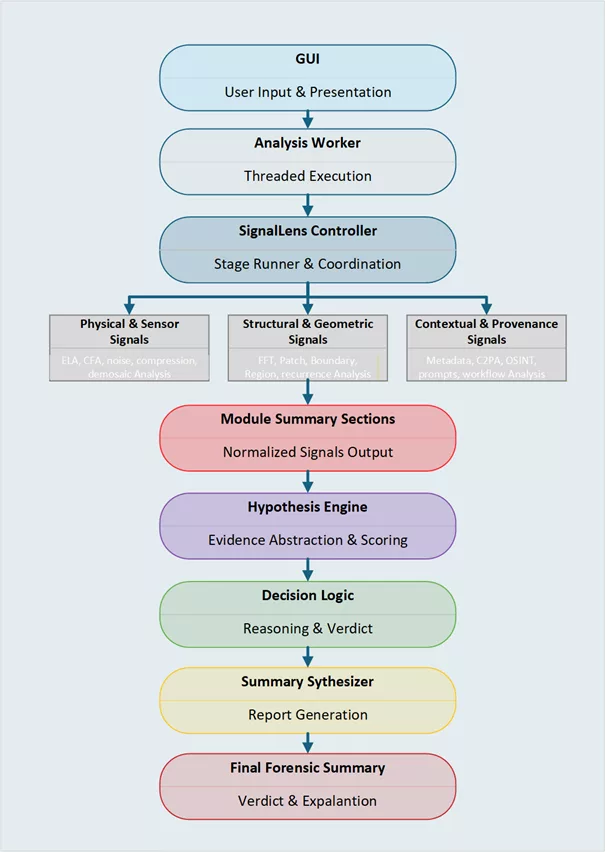
Figure 2, SignalLens Architecture
First, foundational physical evidence is provided by low level physics such as CFA-pattern, noise-variance and error-level-analysis.
If a perfect CFA pattern is found, the system assigns a massive benign (authentic) score. It’s very hard to fake this organically.
Second, structural & geometrical signals ignore the microscopic pixels and focus instead on the mathematical structure and repetition within the scene. These are critical for detecting localized manipulations—like generative fill, inpainting, or deepfake face swapping—where the underlying pixel physics might have been smoothed over, but the geometric structure is unnatural.
If structural signals flag a localized anomaly (like cloned patches), but the ground truth signals show a valid camera sensor background, the engine routes this to a ‘real photo, but manipulated’ pattern rather than a ‘fully synthetic’ pattern.
Third, declarative & contextual signals can act as modifiers. These signals do not inspect the image visually; they analyse its history and mathematical container. Metadata extraction, C2PA checking, and OSINT Reverse Search act as the gatekeepers for the entire decision engine.
If for instance C2PA metadata explicitly declares ‘Generative AI Tool’ or OSINT finds the image on a Midjourney prompt database, this heavily biases the scorecard toward synthetic, requiring overwhelming physical evidence to contradict it.
Ambiguity as a Feature
The true power of the SignalLens container is how it handles ambiguity and contradiction between signals. One of the most important design decisions in SignalLens was accepting that ambiguity is often meaningful.
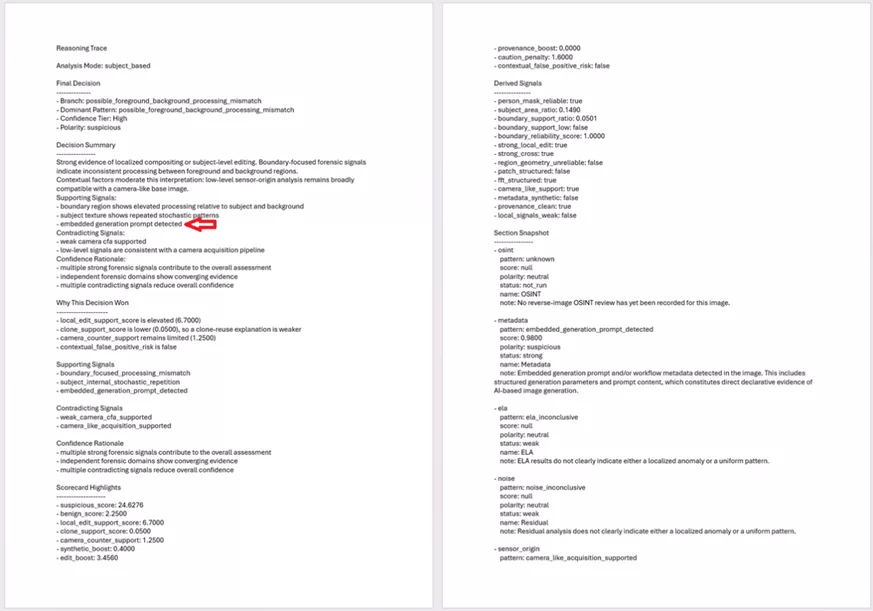
Figure 3, Reasoning Trace (2 of 5 pages shown)
A real smartphone photo can contain synthetic-looking artifacts. A generated image can contain realistic camera signals. An edited image can combine both.
Most tools fail because they compress anomalies into a percentage. SignalLens instead evaluates the tension between the signals.

It recognizes the contradiction, extracts the specific benign and suspicious flags, and outputs a nuanced, explainable narrative. “The structural data is highly anomalous, but the presence of valid sensor noise suggests this may be a heavily computationally-processed real photograph rather than pure generative AI.”
This multi-domain weighting is what allows SignalLens to reason about contradiction instead of collapsing it into a single score.
Note. In the reasoning trace, shown in Figure 3 above, notice the red arrow pointing to the evidence of the prompt used to generate this image. This demonstrates the strict discipline of the arbitration engine.
Even when faced with glaring declarative evidence (an embedded Stable Diffusion prompt), the system does not short-circuit to a ‘smoking gun’ conclusion. It continues to weigh the physical and structural domains independently, treating the prompt as a heavily weighted modifier rather than an absolute override. This prevents injected metadata from easily tricking the system.
The example image analyzed in this article was sourced from a public Reddit discussion on photorealistic Stable Diffusion outputs. We use it here strictly for analytical demonstration purposes.
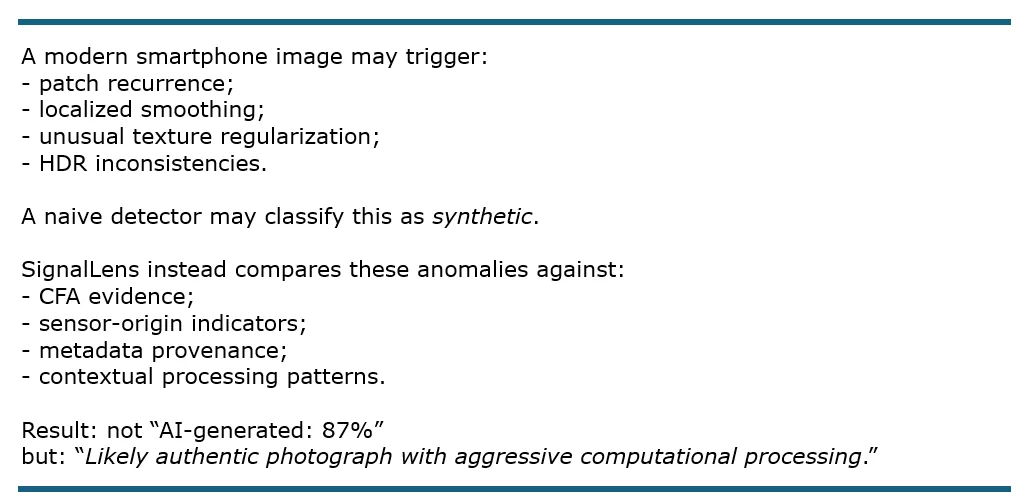
Local Audit trail
SignalLens is not a black box, every analysis produces a local forensic audit trail. SignalLens runs locally. Images do not need to leave the machine.
Every SignalLens analysis of an image creates a local forensic audit trail (under the folder .\analyzed\), with a dedicated folder for each image. This folder contains the evidence behind the conclusion. It holds normalized versions of the image used by the different analysis branches, visual overlays, heatmaps, masks, FFT outputs, metadata signals, JSON module results, logs, summaries in JSON, text and HTML, and a full reasoning trace in JSON and text. Adding up to (currently) 75 files.
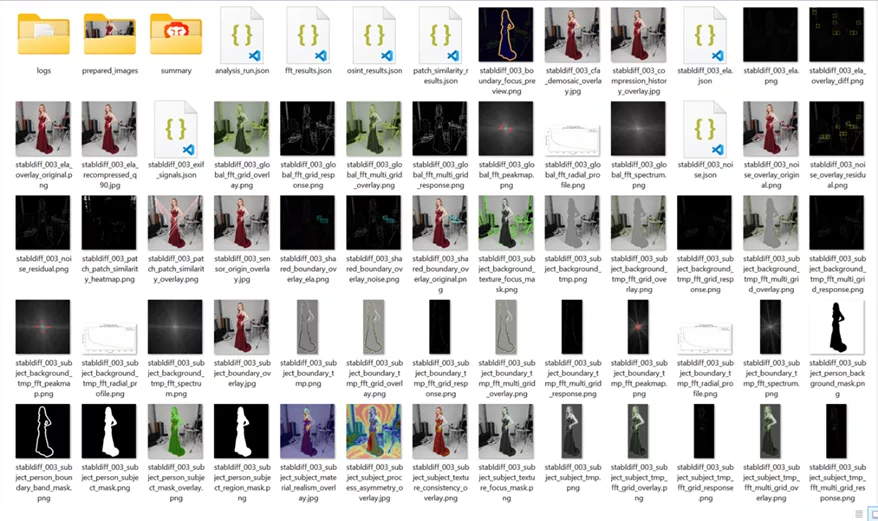
Figure 4: Local Audit trail
SignalLens does not just show a verdict. It preserves the evidence that led to it.
Conclusion: Visual certainty is changing
The future of synthetic media analysis may not belong to systems that pretend certainty exists everywhere. It may belong to systems capable of reasoning under uncertainty and that also provide you with the means to check its reasoning and the conclusions yourself.
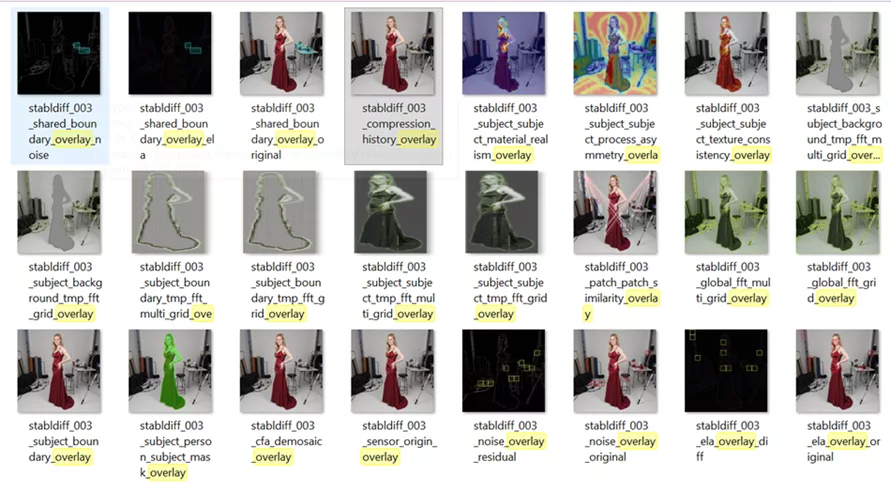
Figure 5, overlays.
Try SignalLens
Currently we prepare SignalLens in two local-first editions:
SignalLens Basic (Free): A lightweight local tool for everyday users and creators who need transparent verification.
SignalLens Pro: A comprehensive local workstation for OSINT investigators, journalists, HRM professionals, E-commerce platform managers and forensic analysts requiring advanced pixel analysis, the full 75-file audit trail, and customizable evaluation thresholds.
Join the early access waitlist here.
A summary of the article has been published on LinkedIn.
Ask a Question or give Feedback about this article