
Engineering lessons behind SignalLens 0.1.0 Beta and why stronger detection still requires explainable evidence
AI image detection is advancing rapidly. On November 4, 2026, Pangram announced Image 1.0, reporting 99.96% classification accuracy on its own evaluation set. The new model also offers localized detection heatmaps and , according to Pangram, improved robustness to image transformations such as compression and resizing.
These advances deserve recognition. But how much does a detection score actually tell us about an image’s origin, history, or possible manipulation?
While rebuilding SignalLens, we encountered a related problem from a different direction. Our forensic pipeline could collect numerous relevant observations and still produce conclusions that were more confident than the evidence justified.
Missing metadata could be interpreted as suspicious. Correlated measurements could be counted as independent confirmations. Early findings could influence decisions before the complete evidence was assessed.
We discovered that collecting more evidence could sometimes make the reasoning worse.
Addressing these problems became a central part of SignalLens 0.1.0 Beta, now available for Windows.
This article examines what we changed, why those changes matter, and why forensic reasoning remains essential even as AI image detectors become more accurate.
The remarkable progress of learned detectors
Image detection has become increasingly sophisticated. Early public advice focused on visible abnormalities like distorted hands, inconsistent reflections, unusual textures or implausible details. These clues are becoming less dependable as image generators improve.
Modern detectors therefore identify statistical patterns from collections of authentic and synthetic images. Their decisions can reflect complex characteristics that are difficult or impossible for a human observer to identify. Pangram’s recent results illustrate the potential of this approach.
Its Image 1.0 release introduces a detector capable of producing localized heatmaps indicating where synthetic content may appear. Pangram also reports improved performance on recent generators, greater robustness to common image transformations, and better handling of low-resolution images.
These are meaningful developments, particularly for detecting images containing a mixture of authentic and generated content. However, strong classification performance and a defensible forensic conclusion are not interchangeable.
The Accuracy Claim Deserves a Closer Look
Pangram’s reported performance is impressive. The headline figure deserves scrutiny however, not because the result is necessarily incorrect, but because it is the benchmark that determines what the number actually means.
For its 99.96% result, Pangram constructed an evaluation dataset from just 100 selected photographs. It then used a dozen AI image generators to create 1,200 synthetic counterparts, using prompts closely matching the original photographs.
This is a reasonable way to control for differences in subject matter between authentic and generated images. Matching subjects can help control for superficial differences between authentic and synthetic datasets, reducing the risk that a detector simply learns to distinguish different types of scenes.
Nevertheless, the evaluation has important boundaries. The disclosed dataset is based on only 100 original photographic scenes. The synthetic images were produced through a controlled process rather than sampled from the full diversity of images encountered in everyday use.
This evaluation alone cannot establish how reliably the detector handles conventional photo editing, computational photography, localized AI modifications, complex processing histories, or generation methods outside the tested distribution.
Nor should performance on a vendor-constructed dataset be confused with independently verified accuracy across real-world conditions.
Pangram also published results from academic benchmarks and robustness evaluations. We should consider those findings alongside its headline comparison. The appropriate conclusion is not that Pangram’s detector is unreliable. It is that 99.96% accuracy describes performance under particular evaluation conditions, not a universal probability that its next judgment will be correct.
Forensic Reasoning
Even if independent benchmarks confirm similarly strong detection performance, a separate question remains. Can a detector explain what happened to an image, distinguish competing explanations, and provide evidence that another investigator can examine?
That is where forensic reasoning becomes essential.
Let’s consider a photograph that has been modified using generative AI. A detector might correctly recognize the synthetic region, perhaps even identify its approximate location. That is valuable evidence. But additional questions remain.
Was the underlying photograph authentic? Was the modification intended to alter the meaning of the scene? Can an earlier version of the image be found? Does the metadata support the claimed origin? Are there alternative explanations for the detected anomalies? Can another investigator review the evidence behind the assessment?
These questions extend beyond image classification.
What Rebuilding SignalLens Taught Us About Forensic Reasoning
During the five months between SignalLens 0.0.1 Beta and version 0.1.0 Beta, the project underwent a substantial modernization of its reasoning architecture and investigation interface.
SignalLens was developed around a multi-signal approach to identifying potentially AI-generated or manipulated images. Instead of relying exclusively on one detector, it examined different characteristics of the image and combined their findings into an assessment.
Multiple forensic perspectives remain valuable. But their usefulness depends on how observations are interpreted, combined, and qualified. The central engineering challenge was no longer simply collecting more signals. It was ensuring that the system drew defensible conclusions from the evidence it already had.
Problems uncovered during the reasoning-engine audit
Premature decision routing
Parts of the earlier reasoning process could steer an investigation toward a conclusion before all relevant evidence had been evaluated. A forensic workflow should distinguish evidence collection from interpretation. Early findings may guide further investigation, but should not predetermine its outcome.
The revised approach places greater emphasis on evaluating all collected evidence before forming an overall assessment.
Missing metadata treated as suspicious
The absence of camera metadata can be consistent with synthetic generation, but it is also common in ordinary images downloaded from social networks, messaging platforms, and image-processing applications. Treating missing metadata as positive evidence of AI generation risks confusing an absence of information with evidence of manipulation.
The correction is conceptually important, unknown is not the same as suspicious.
Correlated signals counted as independent evidence
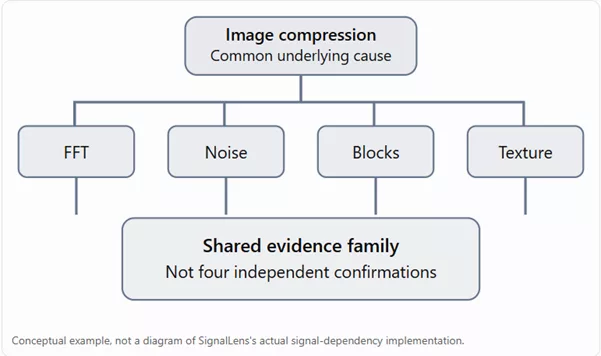
Consider several forensic measurements that all respond to similar frequency-domain artifacts or compression characteristics. If each measurement indicates an anomaly, an aggregation system may treat them as multiple independent confirmations. But those measurements may be observing substantially the same underlying phenomenon. Ten detectors measuring variations of one artifact should not be mistaken for ten independent witnesses.
The reasoning engine must therefore consider relationships between signals, rather than merely count how many support a hypothesis.
Unverified provenance claims
An image’s metadata, an apparent source, or the possible relationship to another image can provide valuable investigative clues. But a candidate source match is not necessarily a verified source. Metadata describing a camera is not proof that the image originated from that camera.
The revised approach places greater emphasis on distinguishing observations, hypotheses, and verified findings.
Inconsistent confidence assignments
Confidence can become misleading when different components apply different interpretations or thresholds. A central confidence policy is intended to make those assessments more consistent and prevent individual analytical stages from independently overstating the strength of their conclusions.
This does not automatically make confidence statistically calibrated. That requires separate empirical validation. It does, however, establish a more coherent framework for expressing the significance and limitations of evidence.
When several signals tell the same story
Consider an authentic smartphone photograph that has been resized, compressed, and uploaded to a social-media platform. Its original EXIF metadata has been removed. Compression introduces unusual frequency patterns, while image-processing operations affect noise characteristics.
A multi-signal system might report camera metadata missing, frequency-domain anomaly detected, noise inconsistency detected, and, compression irregularity detected. Four suspicious findings taken together could appear to provide a compelling case for AI generation.
But that reasoning is questionable.
The missing metadata in itself is not positive evidence of synthetic generation. The other three observations may be related consequences of the same processing history.
A more defensible assessment would recognize that the findings are compatible with ordinary image processing, that some evidence may be correlated, thus, that the available observations do not really establish synthetic origin.
The individual measurements may be technically correct while the combined conclusion is wrong.
This is a conceptual example rather than a measured comparison between SignalLens versions. It illustrates the type of reasoning problem addressed during the redesign.
The broader lesson is that accumulating evidence without examining its dependencies can create an illusion of corroboration. More observations do not necessarily mean more independent information.
From a collection of detectors to an investigation engine
Improving the reasoning-engine in SignalLens 0.1.0 Beta is part of a broader architectural modernization.
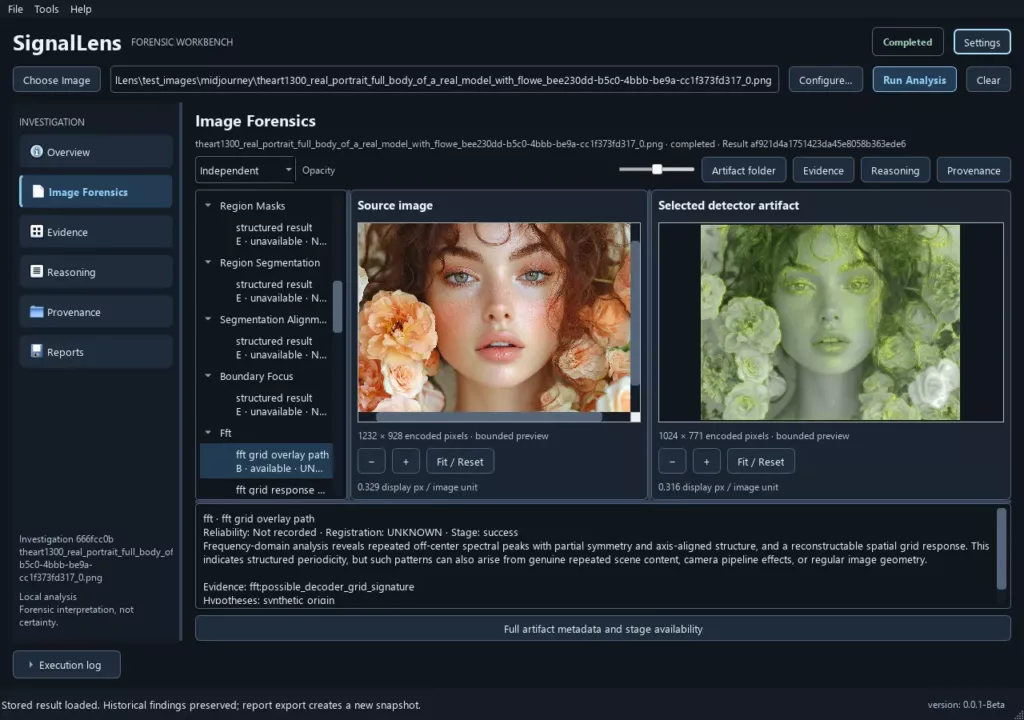
The new release introduces a more integrated investigation experience, organized around six related workspaces: Overview, Image Forensics, Evidence, Reasoning, Provenance, and Reports.
The objective is to make the relationship between observations, interpretations, and conclusions easier to follow for the person conducting the investigation. Instead of presenting only an outcome, the interface enables users to explore the supporting evidence, examine reasoning paths, and identify where uncertainty remains.
Behind the interface, the modernization introduces architectural safeguards including immutable presentation contracts, investigation identity, controlled artifact registration, and consistent reporting snapshots. These mechanisms help keep the displayed findings, their underlying evidence, and exported reports aligned.
They do not replace independent detection benchmarks. They address a different engineering requirement: making the investigation process more coherent, inspectable, and reproducible.
Inside the new SignalLens investigation experience
The redesigned interface turns this reasoning approach into a practical investigation workflow.
Overview: Understand the case
The Overview workspace presents the analysed image, principal findings, and separate forensic hypotheses. It provides a starting point for understanding the overall assessment without requiring users to accept a single unexplained score.
Image Forensics: Inspect the signals
We can explore forensic observations through detector outputs, masks, overlays, and spatially registered artifacts. This allows users to inspect where measurements originate and compare visual evidence against the analysed image.
Evidence: Examine the supporting observations
The Evidence workspace organizes findings by their evidential roles, reliability, and lineage. Users can investigate the observations supporting an assessment and explore their relationship to competing hypotheses.
Reasoning: Challenge the interpretation
The Reasoning workspace provides access to hypothesis assessments, decision routes, corroboration, score contributions, confidence policies, and raw reasoning traces. Its purpose is not to manufacture certainty from inconclusive evidence. It is to make the interpretation of that evidence more transparent and open to scrutiny.
Provenance: Investigate the image’s history
The Provenance workspace examines recorded metadata, generation declarations, and contextual information. It also supports external open-source research where appropriate.
Once a candidate source image has been located, SHA-256 hashing can establish whether two files are byte-for-byte identical. Different hashes, however, do not rule out a common visual origin or a relationship between transformed versions. Candidate matches, metadata claims, and verified evidence must therefore remain distinguishable.
Reports: Preserve the investigation
SignalLens provides investigation previews and exports in HTML, JSON, and text formats.
Reports and reasoning traces are generated from consistent investigation snapshots, helping preserve the relationship between observed evidence and the conclusions documented at the time.
Together, these workspaces support a coherent process: Inspect, Understand & Document.
The result is not merely a redesigned interface. It is an attempt to make the underlying reasoning available to the person who needs to assess, verify, or challenge it.
Provenance adds a different dimension
Content-based detection examines characteristics of the image itself. Provenance investigation asks different questions: where the image originated, whether earlier versions exist, and what evidence supports its claimed history.
These two approaches are complementary. An AI-generated image may be correctly classified without revealing who created it or how it entered circulation. One may incorrectly attribute a genuine photograph to an event or location. In that case, the photograph itself may be authentic while the accompanying claim is misleading.
An edited photograph may contain both authentic and synthetic material. Understanding that mixture can require more than a whole-image classification.
Provenance evidence also has limitations. Metadata can be missing or altered, source matches may be incomplete, and the absence of a verifiable origin does not establish that an image is synthetic.
The objective is therefore not to choose between content-based detection and provenance investigation. It is to examine how and where different forms of evidence support, qualify or contradict one another.
What has changed since SignalLens 0.0.1 Beta?
Below a summary of the main improvements in the new SignalLens version.
| Earlier beta | Current SignalLens |
| Multi-signal forensic assessment | More structured interpretation of forensic evidence |
| Potential for premature conclusion routing | Revised reasoning and decision policy |
| Missing metadata could affect suspicion | More careful treatment of missing information |
| Correlated measurements could accumulate | Improved treatment of related evidence |
| Provenance claims required stronger qualification | Clearer distinction between candidates and verified sources |
| Earlier investigation interface | Six-workspace investigation experience |
| Earlier reporting architecture | Consistent investigation/report snapshots |
The important distinction is that these improvements do not establish superior image-classification accuracy. SignalLens does not claim to outperform leading learned detectors. Instead, version 0.1.0 Beta focuses on making forensic assessments more structured, explainable, evidence-oriented, and reviewable.
Uncertainty remains part of the answer
Even highly accurate detectors make mistakes.
A small false-positive rate can have meaningful consequences when large numbers of authentic images are analysed. Incorrectly identifying a genuine photograph as AI-generated can affect photographers, journalists, creators, and others whose work depends on visual credibility.
The relevant question is not only how often a system is correct. It is also how errors arise, how uncertainty is communicated, and whether a disputed conclusion can be examined.
Forensic signals may be ambiguous, incomplete, dependent on one another, or affected by ordinary image processing.
A responsible investigation should distinguish observation from interpretation, disclose meaningful limitations, and avoid presenting probabilistic findings as conclusive proof.
Sometimes an investigation must end without a definitive answer.
That is not necessarily a failure. It may be the most defensible conclusion the available evidence permits.
A research challenge worth pursuing
Pangram’s reported progress also creates an important research opportunity for SignalLens.
A future SignalLens evaluation should examine authentic camera photographs, fully synthetic images, localized AI modifications, conventional editing, computational photography, compressed and resized images, mixed-provenance cases, and outputs from unfamiliar generators.
Pangram’s reported progress also creates an important research opportunity for SignalLens.
A future SignalLens evaluation should examine authentic camera photographs, fully synthetic images, localized AI modifications, conventional editing, computational photography, compressed and resized images, mixed-provenance cases, and outputs from unfamiliar generators.
Pangram’s reported progress also creates an important research opportunity for SignalLens.
A future SignalLens evaluation should examine authentic camera photographs, fully synthetic images, localized AI modifications, conventional editing, computational photography, compressed and resized images, mixed-provenance cases, and outputs from unfamiliar generators.
Pangram’s reported progress also creates an important research opportunity for SignalLens.
A future SignalLens evaluation should examine authentic camera photographs, fully synthetic images, localized AI modifications, conventional editing, computational photography, compressed and resized images, mixed-provenance cases, and outputs from unfamiliar generators.
bPangram’s reported progress also creates an important research opportunity for SignalLens.
A future SignalLens evaluation should examine authentic camera photographs, fully synthetic images, localized AI modifications, conventional editing, computational photography, compressed and resized images, mixed-provenance cases, and outputs from unfamiliar generators.
We should assess two dimensions separately. First, classification and localization performance, including false positives, generalization, and robustness to transformations.
Second, forensic usefulness: whether observations are traceable, alternative explanations are considered, uncertainty is represented appropriately, and assessments can be reproduced and challenged.
These are related but different research objectives. Independent comparative testing remains necessary before drawing conclusions about SignalLens’s relative detection performance.
SignalLens 0.1.0 Beta is available now
Five months after the original beta, we have rebuilt SignalLens around a more demanding principle. A forensic conclusion should be something you can investigate, not simply accept.
The release introduces a revised reasoning approach, an integrated six-workspace interface, clearer treatment of evidence and provenance and more consistent reporting.
The application remains local-first, allowing core forensic analysis to run on a Windows computer. You can use external research where you need contextual verification.
We managed to reduce the portable Windows distribution from approximately 337 MB to 227 MB.
Explore SignalLens 0.1.0 Beta and download the Windows release
SignalLens remains experimental software. We should treat its findings critically and not as a substitutes for independent verification.
Help improve SignalLens
Feedback is particularly welcome on false positives involving authentic or conventionally edited photographs, cases where forensic signals conflict or the reasoning appears overstated, and, provenance investigations where the evidence is incomplete or ambiguous.
Useful feedback should include the SignalLens version, relevant reasoning/report excerpts, and a description of the expected versus observed behaviour. Share original images only when you have permission to do so.
Beyond the detection score
The progress demonstrated by Pangram and other researchers is encouraging. Better detectors can substantially improve the ability to identify synthetic content and localize manipulated regions.
But detection performance and forensic accountability address different needs.
As automated assessments increasingly inform consequential decisions, the ability to explain, verify, reproduce, and challenge their conclusions becomes more important—not less.
The question is no longer simply whether a detector can distinguish authentic from synthetic images. It is how reliable detection, provenance evidence, and transparent reasoning can work together.
A detection score can tell us what a model suspects. A forensic investigation should help us understand what the evidence actually establishes. That is the direction SignalLens is exploring.
References
Pangram, Introducing Pangram Image 1.0, November 4, 2026: https://www.pangram.com/blog/introducing-pangram-image-1-0
Pangram, Introducing Pangram Image Detection (Research Preview), July 29, 2026: https://www.pangram.com/blog/introducing-pangram-image-detection
Earlier articles on SignalLens
In the last half year before this post a series of articles on SignalLens has been published. You can find them here.
26-05-08 https://code2trade.dev/why-ai-image-detection-is-broken/
26-05-14 https://code2trade.dev/beyond-ai-detection-building-signallens/
26-06-06 https://code2trade.dev/signallens-beta-now-available-for-testing/
26-06-18 https://code2trade.dev/what-should-replace-the-expert-eye-once-the-expert-eye-is-no-longer-enough/